|
..continued
Late 18th Century - The Burrell
Family
After Rider’s death the estate was put up for auction, and was bought by Sir Charles Raymond for the price of £18,900. The sale particulars provide a brief description of the estate, and go on to suggest that the site offered great potential for future development. They
state:
‘[These are] The particulars of a valuable and Extensive Freehold Estate consisting of the Manor of Knepp and 9 Contiguous Farms with Knepp Mills and Pond. Containing altogether 1600 acres of rich arable, meadow, pasture and woodland. . .which will be sold by Auction by Mr Willock at the Rainbow Coffee House in Cornhill, London on Friday the 23rd of November 1787 at 12
o’clock.
This estate is perfectly compact, lying all within a Ring-Fence, and there is a FISH-POND of EIGHTY ACRES, in the centre of it; near the upper end of which, at a proper Distance from the Turnpike Road, is an ELEVATED AND BEAUTIFUL SPOT, to build a house upon, and which would command uninterrupted Views over the whole Estate, and the adjacent country of the SOUTH DOWNS’
But Sir Charles died in the following year and the estate was left to his two daughters Dame Sophie, wife of Sir William Burrell and Juliana, wife of Henry Boulton. In 1789 Juliana sold her share to Sir William, and thus the whole estate came into the control of the Burrell family, in whose ownership it has remained to the present
day.
Sir William Burrell (2nd Bt) was a very keen archaeologist and historian. Between 1771 and his death in 1796, he carried out extensive research into the county’s history and compiled a detailed set of manuscripts containing his hand-written notes, with a view to writing The History of Sussex. As a part of this work Sir William commissioned the artists Samuel Grimm and James Lambert to paint an extensive series of views around the county. Although the majority of these water-colours concentrate on ecclesiastical and archaeological subjects, there are a number of views around the Knepp Castle Estate, showing the character of the Pond and the Ruin. A view of Knepp Castle and West Grinstead church by Grimm is reproduced
below and depicts the character of the agricultural landscape surveyed by
Crow.

W.
Grinstead Church and Knepp Castle by
S.H.Grimm, dated 1789
Sir William died before completing this work, and in his will he bequeathed the manuscripts and paintings to the British Museum, where they survive as the Burrell
Collection
Early 19th Century Development of the Designed
Landscape.
When Sir William died in 1796 the estate was inherited by his son Sir Charles Merrick Burrell (3rd Bt), whose younger brother Walter was later to inherit West Grinstead. In 1806 the OSD series map was published at a scale of 2’’ to 1 mile, a copy of which is shown at figure 3. Despite its small scale, this map series was surveyed in remarkable detail and it indicates two notable changes within the estate.
Firstly, an area lying between the Knepp Mill Pond and the Horsham Road had been cleared of its hedgerows, and the particular graphic used on the map suggests the existence of an area of parkland. The northern, eastern and southern boundaries of the parkland had been planted with woodland belts, in the style fashionable during the late 18th century English Landscape Movement. But this park appears unrelated to any form of building. One explanation might be that it had been developed as an extension of the neighbouring West Grinstead Park; after all, the two estates were owned by brothers. But the existence of a broad belt of agricultural land dividing the two areas casts doubt on this theory.
Alternatively, Sir Charles may have laid out this parkland in advance of the imminent construction of a new house. If this were the case it might indicate that he had originally intended his house to be constructed to the east of the Knepp Mill Pond. Or, it could be that at the time that this area was surveyed, work to create the whole park was only partly completed, and that he stripped out the hedgerows on the western side of the pond soon after this survey was
recorded.

Sir
Charles
Secondly, in 1800, records indicate that Sir Charles financed the construction of a new road between Coolham and Cowfold. The 1806 map shows that this new road (or rather a track) had been formed, passing east to west in the northern part of the current study area (although it does not appear to extend further east or west after leaving the estate). The route that the road took crossed what had been the northern end of the Hammer pond (as shown by Crow). In order to achieve this it appears that the water level in the pond may have been lowered, and thus reducing the overall size of the pond
.
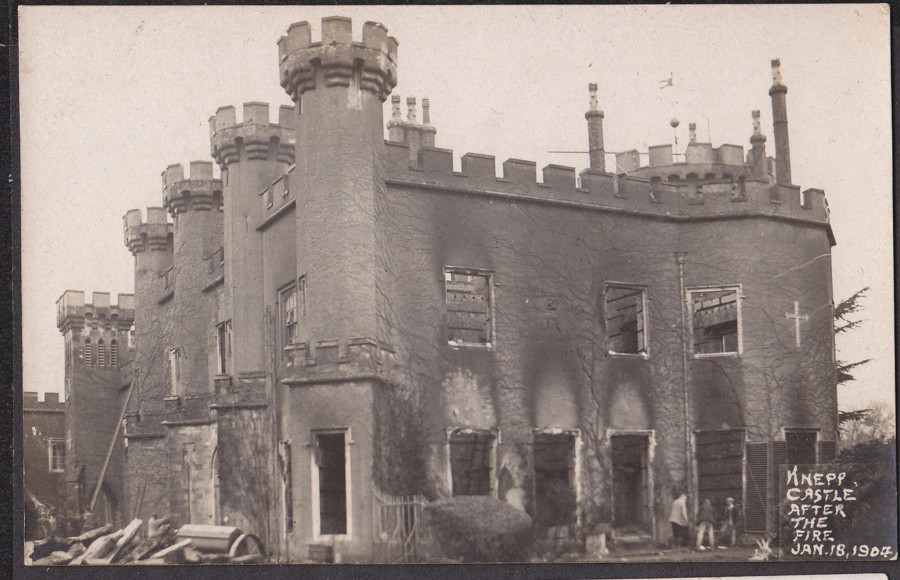
In about 1808 Walter Burrell commissioned John Nash to design and build a new house at West Grinstead. In the same year, Nash was also commissioned by Sir Charles Burrell to design and build a house at Knepp. The construction of both houses began the following year and Knepp was completed by 1812 at a cost of £28,500. Unlike West Grinstead where Nash used real stone, the Castle at Knepp was constructed entirely from brickwork, rendered in stucco and lined out to simulate stonework. The bricks were fired on site and the timber was cut from the estate woods. The local Horsham stone was only used for construction of the main
porch.

Knepp
Castle, etched by Charles Smith from a
drawing by Lady Burrell, dated 1830
No records survive relating to the laying out of the grounds, but it is likely that an area of parkland was laid out at the same time as the castle was being built. A survey by Christopher and John Greenwood was published in 1825, a copy of which is reproduced at figure 4. This plan shows the building in place with the area immediately to the south east and west laid out to parkland, and forming its setting. Two drives lead northwards across the parkland from Castle Lane. They meet and sweep around the eastern side of the house, and continue northwards as a single drive running parallel with the pond, joining the Cowfold to Coolham road (A272) at Lodge Farm. The graphics used on this map would suggest that West Grinstead Park and Knepp Castle formed a continuous area of parkland, divided only by Horsham to Steyning Road (A24). The remainder of the study area is shown in plain graphic, suggesting that it remained in
agriculture.
An illustration by Charles Smith published in Cartwright’s ‘Parochial Topography of the Rape of Bramber’ in 1830 (refer to figure 5b), shows the castle situated in a parkland setting with an area of woodland extending behind the building down the banks and to the edge of the Pond. The Park is shown grazed by sheep. Whilst the castle itself appears to be drawn accurately, the close proximity of the building to the water and the exaggerated nature of the topography behind suggests considerable artistic licence has been employed. The woodland that forms the backdrop to the castle in this view is not shown on the Greenwood survey, which could indicate that the Pleasure Grounds were laid out in the intervening period, and that the artist has shown what the view would be like once the trees had grown up. However, it is more likely that the Pleasure Grounds were in existence, or at least an area of woodland existed in 1825, but that the very small scale of the survey plan (1’’ to 1 mile) prevented it from being
shown.
The engraving might, therefore, be a fairly accurate reflection of the overall character of the view. When the same illustration was reprinted in Horsfield’s ‘History, Antiquities and Topography of the County of Sussex’ in 1835, and it was accompanied by the following
description:‘
[Knepp] is situated on a gentle elevation, commanding some interesting scenery, and overlooking the most extensive piece of water south of the River Thames and which derives additional beauty from its serpentine form, adorned as its banks are, by fine timber and plantations’
Water-colour
of Knepp Mill pond by Lady Burrell
c1820

|